
"I Am Not a Cult"
How Three Prominent Figures Illustrate Leader-Group Dynamics with High-Devotion Followers
What’s the deal with cults, anyway? The question sounds like a lead-in to a stand-up comedy routine. When queried along those lines about their own following, at least three high-profile individuals responded with the exact same phrase: “I am not a cult.”
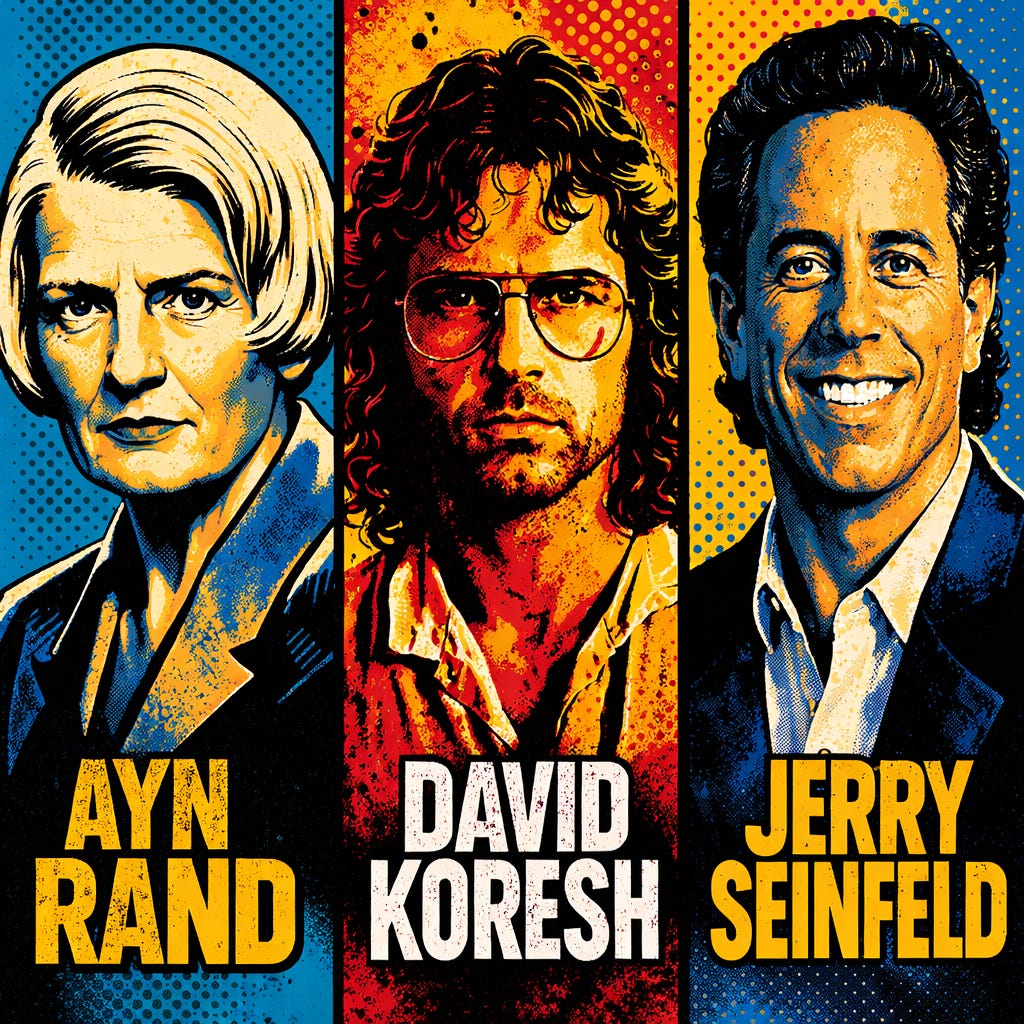
The phraseology is worth pausing on. Notice the juxtaposition of individual (“I”) and group (“a cult”). This quick and undeniably factual side-step could only be exploited by cults with individual leaders and was done so identically, decades apart, by these three wholly unrelated nabobs. The three charismatic figures in question — Ayn Rand (philosopher-novelist), David Koresh (Christian sect leader), and Jerry Seinfeld (an entertainer with an extraordinarily large and devoted fanbase) — motivate this analysis of the phrase’s significance and of the individual-versus-collective paradigm in cults.
What’s a cult?
Definitions of cults are numerous and varied, often focusing on the religious subtype. A common, if unofficial, definition in Silicon Valley startups abstracts religion and other specifics, yielding a useful working definition along the lines of:
A cult is a subgroup that differs systematically from mainstream culture in ways the larger society may find strange or distasteful.12
This definition is flexible enough to describe a business, personality, religious, or social cult equally well. Sports and entertainment celebrities, or even non-human entities like films and books, similarly, can be said to have a “cult following” if their devotees are devoted to the point of seeming “weird” to others.
Not all cults are dangerous, although there have been many cults to fail famously, sometimes even resulting in criminal prosecution or suicides. Such is more often the case when the cult is also a high control group, in which the organization exerts significant power over followers through intrusions into personal relationships or beliefs, information control, or the erosion of individuality.3
As our society becomes more globalized and interconnected, the prevalence of high-control business and social collectives has risen, whereas “personality cults” and other individualist-style cults have become taboo and are often pressured to dissolve or assimilate into the collectivist culture. Is individualistic leadership the hallmark of a high-control group? Could the “I am not a cult” gimmick be a method their leaders use to evade social control and continue their self-glorification at the expense of followers?
Individualist and Collectivist Cult Structures
Upon examination, both structures — individual-centered and collectively organized — appear to have long existed. Jesus Christ is probably the most famous of the individualist leaders throughout history, and his cult succeeded on a large enough scale for a long enough period to go from a tiny, persecuted minority to fully mainstream. Other successful personality leaders include Elvis Presley, Steve Jobs, and Walt Disney. Others, like occultist Aleister Crowley, on the other hand, achieve quick growth for their movement early on, but wane from changing times or personal failures.
Collectivist cults of varying degrees of effectiveness and social value date equally far back throughout history. The Roman cult of Liber, associated with sexually violent “Bacchanalia” festivals, took a long time for the Senate to control, because they were group-organized and lacked any significant figureheads to target. Organized crime, from the Italian mafia to China’s Triads, typically utilizes collective leadership, as have the Christian Flagellants for over seven centuries. Much more relevant to today’s times, some Multi-level Marketing (MLM) companies have met not only the definition of a cult, with corporate-style group leadership, but even as high-control groups sometimes representing social or financial danger to their members.4
As in the case of MLMs or highly energetic and high-control Silicon Valley shops, collectivist cults flourish today, mostly unabated, to the extent that they do not run afoul of one another. It seems that both styles of leadership can result in either a healthy, successful culture (as with Jesus or startups) or abusive, dangerous outcomes (for example, Charles’ Manson’s crime gang, or predatory MLMs), so why are individual-led cults targeted, and what is the significance of the “I am not a cult” response from their leaders?
Comparison of 3 Personalities and Their High-Devotion Followers
Turning back to our three famous personalities, we may better understand their commonalities by appreciating their differences.
Ayn Rand can be distinguished as the most intellectual and, arguably, the most “political” of the three. As such, she was subject to systematic attempts by the authoritarian, collectivist Left and the aggressively religious of the conservative Right. David Koresh, the friendly, uneducated Bible expert and guitarist, differed from Rand and Seinfeld by being directly integrated into the lives of each of his close followers, most of whom he or his closest associate, Steve Schneider, personally recruited. Koresh and Rand both faced many detractors, but the accusation of criminal misconduct against Koresh led to a more severe negative reception (although much of the public information about Koresh during his life proved to be exaggerated, mitigated, or false after his death).
Seinfeld, as a popular entertainer with very little political controversy, enjoys the distinction of being by far the least controversial and most financially successful, although perhaps only modestly more well-known than Ayn Rand (based on a quick, informal analysis using Google Search).5 The nearly universal adoration directed at the comedian is a major clue to the meaning of the phrase, uttered verbatim by all three public figures.
It was during a recent conversation between a researcher and the Comedians in Cars Getting Coffee and Unfrosted actor that Seinfeld clarified his status as an individual rather than a cult, saying “I am not a cult,” verbatim. Earlier in the same conversation, he had mentioned his ongoing efforts to convey a separation of his personal identity from that of his characters and on-stage comedy persona — and perhaps that separation of the individual is the key to understanding “I am not a cult.”
At-will Dissociation
The advantage these three leaders share relative to their multi-person counterparts is the luxury of switching at will between speaking as individuals and speaking on behalf of their supporters. Given that this kind of supposed “cult” may be systematically targeted, perhaps due to an unfounded belief that the individualist style of cult is more likely to lead to a dangerous, high control group than a collectively run organization, it serves a clear pragmatic benefit to the leader6.
As an individual, each is far more defensible in the face of detractors. To Rand, for example, it represented, among other things, the ability to unburden herself of any misinterpretations or poor applications of her philosophy by her followers, leaving only her highly vetted, intellectualized, published philosophical propositions to answer for.
What of the followers? Given their high level of devotion, is the switch from figurehead of a movement to “defensive” private individual a betrayal of their following?
Not necessarily. Although it has the potential to leave highly devoted followers who are dependent on their leader feeling undefended or betrayed, the net social impact would seem to depend on the nature of the relationship between the followers and leader; more specifically, it depends on leadership transparency, and the resultant expectations of the followers, as well as the extent to which those leaders live up to those expectations.
Heterogeneous Effects of Leader Individuality
We expect Jerry Seinfeld to be completely hilarious, and he never lets us down. Beyond that, there are very few reasonable expectations one might have of the actor-comedian, except perhaps that he has some experience with women and knows a thing or two about breakfast cereal. With these reasonably low expectations of entertainment gurus, the at-will disassociation from followers (fans) is purely harmless and to be expected, much as the shifts between “Jerome the person” and “Jerry the comedian”, both of whom would be welcome in any circle.
Even David Koresh, with his much closer proximity and higher control group, often used these shifts productively. Despite being a messianic figure within his church, he would transparently step out from his group role as a prophesized leader and into his role as an openly flawed, “sinful” individual.7 Those moments allowed his group, which otherwise accepted his words as the authority of a god, to see him as a simple human being whose wisdom could be questioned. Other times, the shift of a leader to an individual perspective may have negatively impacted the cult’s followers, such as when Koresh, bleeding from multiple gunshot wounds and near death, diverted the government’s attention from his followers’ injuries to his own.
In Rand’s case, the shifts were not only a direct and obvious application of her philosophy of self-interest but also a highly productive and (ironically) socially valuable tactic. The consistency of her individualistic values allowed her to properly explicate and defend the Objectivist philosophy, without the burden of having to vouch for the actions or beliefs of her many followers.
The Deal with Cults, Redux
So, what is the deal with cults, anyway?
It’s like they either have one guy claiming to have all the answers, or it’s run by a high control group where no one has accountability, but everyone else thinks they’re your boss, and they’ve all got your passwords. Unless it’s an entertainer’s cult, of course... the worst thing that happens with those is that you lose $60 for a photocopied autographed photo and your dignity at the merch table.
Although those differences can sometimes yield greater competence in specific areas (for instance a high-control multilevel marketing cult may be highly effective at sales).
For a living collection of resources on cults, see the following folder of my Zotero library: https://www.zotero.org/hackr/collections/RMQDC9HC/collection
Soul in Motion Counseling. “High Control Groups: What They Are and How to Know If You Might Be in One.” n.d. https://soulinmotioninc.com/high-control-groups-what-they-are-and-how-to-know-if-you-might-be-in-one/.
Unplugged Psych. “Escaping High Control: Leaving a Restrictive Group.” n.d. https://www.unpluggedpsych.com/escaping-high-control-leaving-a-restrictive-group/.
Walsh, Froma. “The Concept of Family Resilience: Crisis and Challenge.” Family Process 35, no. 3 (1996): 261–81. https://doi.org/10.1111/j.1545-5300.1996.00261.x.
For an entertaining and highly realistic fictional representation, see: “Peggy’s Gone to Pots.” In King of the Hill. USA, 2007. https://www.imdb.com/title/tt1028739/.
These simple searches served as basic validation of perceived differences in fame levels and sentiment surrounding the three figures. Google was selected as the search tool due to its highly useful search operators.
Search term: # of results on Google
I. Name only
1. “Jerry Seinfeld”: 3.43M
2. “Ayn Rand”: 2.73M
3. “David Koresh”: 259k.
II. % of results retained after adding the term “evil.”
Name + “evil”
1. “David Koresh”: (20.5%, 53.1k)
2. “Ayn Rand”: (16.9%, 461k)
3. “Jerry Seinfeld”: (5.9%, 203k)
Harimoto, Stephanie. “What Is a High Control Group?” n.d. https://www.stephanieharimototherapy.com/blog/what-is-a-high-control-group.
The term “Sinful Messiah” was used by Koresh for himself as an admission of imperfection and humanity to his followers. The term was later turned against him in a series of articles published by the Waco Tribune-Herald, leading up to the attack on Mount Carmel Center, where he and over a hundred of his followers lived.


