


The body of work on Objectivism and Objectivists is large enough to overwhelm anyone trying to cover it in a reasonable amount of time. Recently, this was an issue when trying to catch up on the last twenty years of posts and publications by the Objective Standard Institute (OSI) and its print publication’s company, The Objective Standard (TOS). To provide a broad, high-level understanding of their contents and history, data scraping and text mining were leveraged—the plots and tables below show the results, and a database of citations is available on Zotero.
Data collection produced citation data for 2,574 TOS articles, 391 OSI posts, and 79 additional articles from Prometheus Foundation—a related entity that both funds and critiques OSI. The documents were penned by 229 authors over the course of approximately 20 years.
Since Prometheus Foundation is focused on funding and commentary of OSI and its other grantees, their articles were excluded from the text mining data set but are available as citations in this Zotero collection. OSI published a combination of editorial articles and organizational announcements and were therefore retained in the text mining data set, with TOS’ much larger corpus of posts. Zotero collections for OSI and TOS are also available.
Some posts were tagged by topic, however the vast majority of the tags were only used once, limiting their value here, but with some repeated tags such as “Ayn Rand” and “Objectivism”.
Although citation data was not restricted, the full text of some articles was partially or completely paywalled. To avoid biasing the statistics used to evaluate the data, very short posts such as those that were paywalled or those missing key metadata were dropped from the analysis of the raw text, leaving 1,773 articles in the text mining corpus (318 from OSI and 1,458 from TOS).
Structural Topic Modeling (STM) was the specific bundle of text mining techniques I used to group articles by their most important words or word combinations to determine the most common topics. This R language implementation of STM involved four statistics used to rank the most important terms in each document (post). Although the exact term rankings varied slightly, all four metrics yielded the same topics, showing stability in the results. One of the four, FRequency and EXclusivity or “FREX” is shown in the table below.
Since publication dates were available, I thought it would be interesting to find out how the proportion of those topics changed over time.
OSI-related announcements (OSI Activities) were consistently high after 2006 and were the overall most frequent communication type. War & American History mostly remained popular, but seems to have slightly waned since 2018. Interest in Psychology & Lifestyle seemed to have fallen off after 2006 - 2007 until 2018, when it began to fill the place of declining War & American History stories. Science was usually the least prevalent of the major topics.
The most notable trend was a decline in Moral Philosophy since 2017. It’s not immediately apparent from the chart why that may have been the case, other than the uptick in lifestyle. It struck me that the changes here could be related to changes in the staff. The next two charts helped me to visualize authorship, although this exploratory data analysis is insufficient to show a causal link.
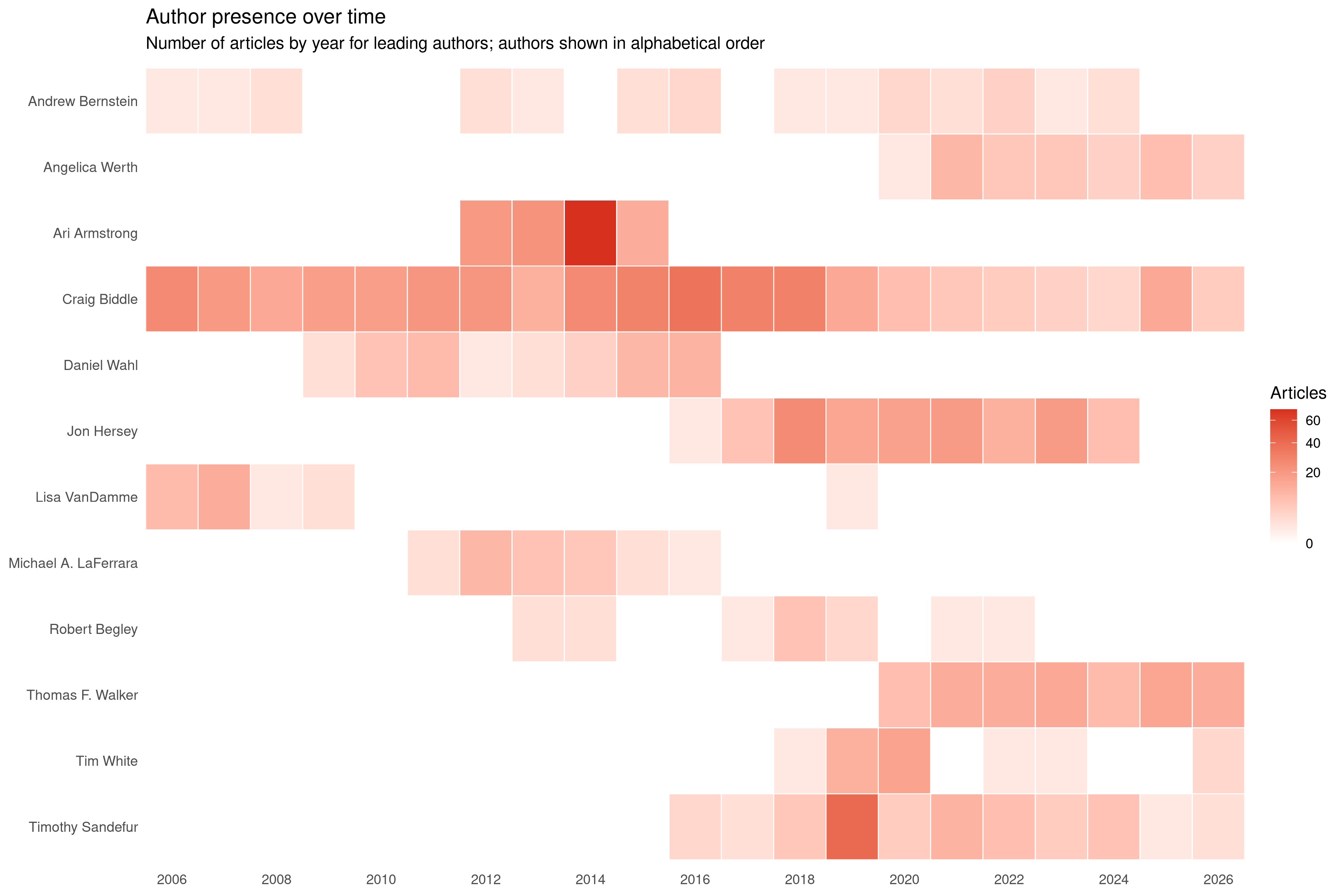
Given the large number of one-off or infrequent authors, I limited the visualization to only the most prolific OSI/TOS writers. These last two are static images I created with code, so they may be less responsive across devices; however, the raw data behind the charts, as well as the code, is available on GitHub.
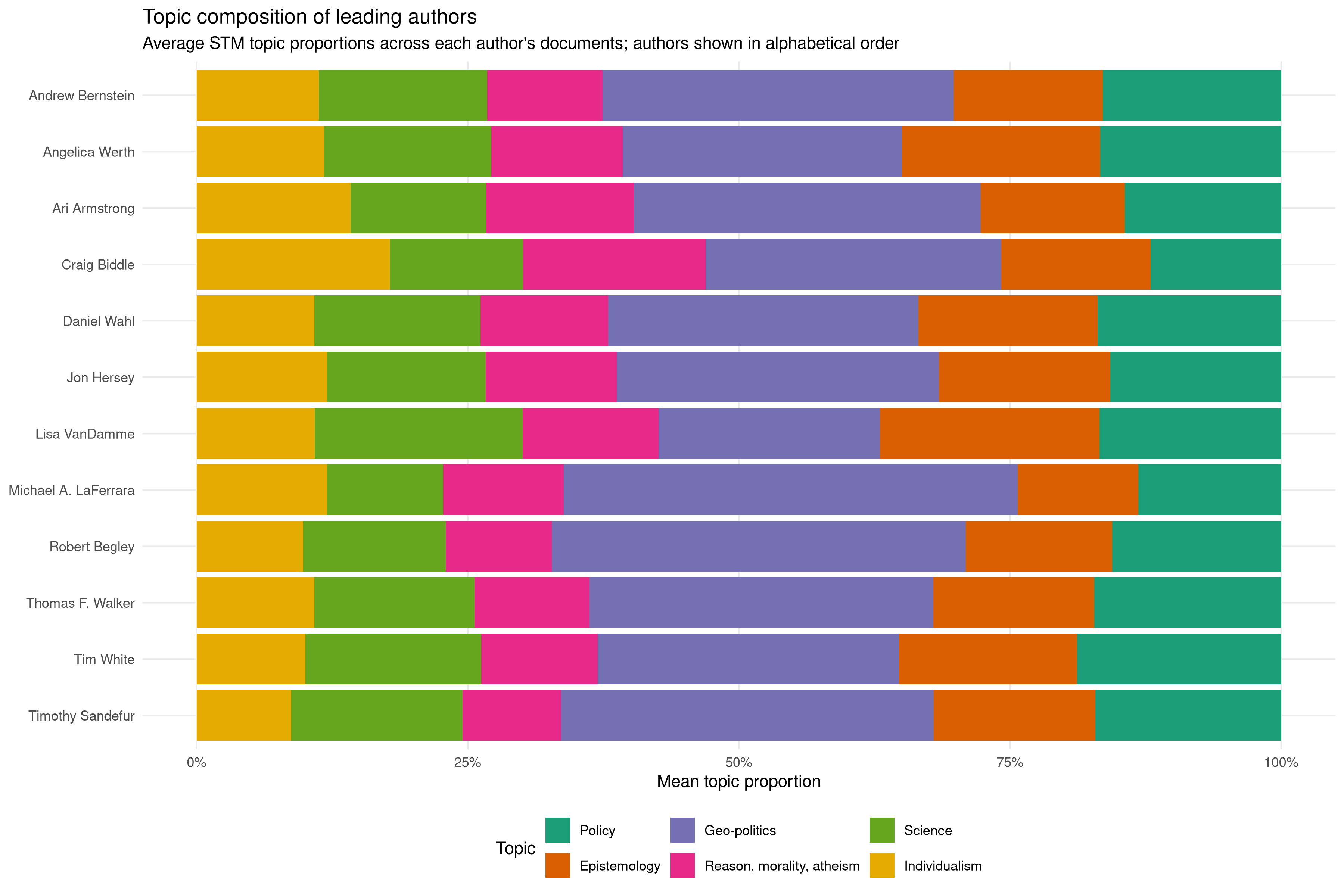
In truth, this aggregated analysis only provides minimal insight into the content produced by OSI and TOS. There’s no substitute for actually reading their articles, but the collected data, which has been added to the SQLite D1 database behind WhoNeeds.it will hopefully provide a springboard for further analysis and the Zotero collections may aid writers or researchers.
Finally, to give credit to the many authors not represented above, here’s a list of all OSI and TOS known to me at the time of writing. If anyone is missing, please let me know.