

Postsocialist Press has published several interactive entity‑relationship (“network”) graphs of the Objectivist movement as open access web apps. While the graphs and their underlying database are still incomplete and under active development, they are open for exploration, and users are invited to submit any corrections or additions they would like to see.
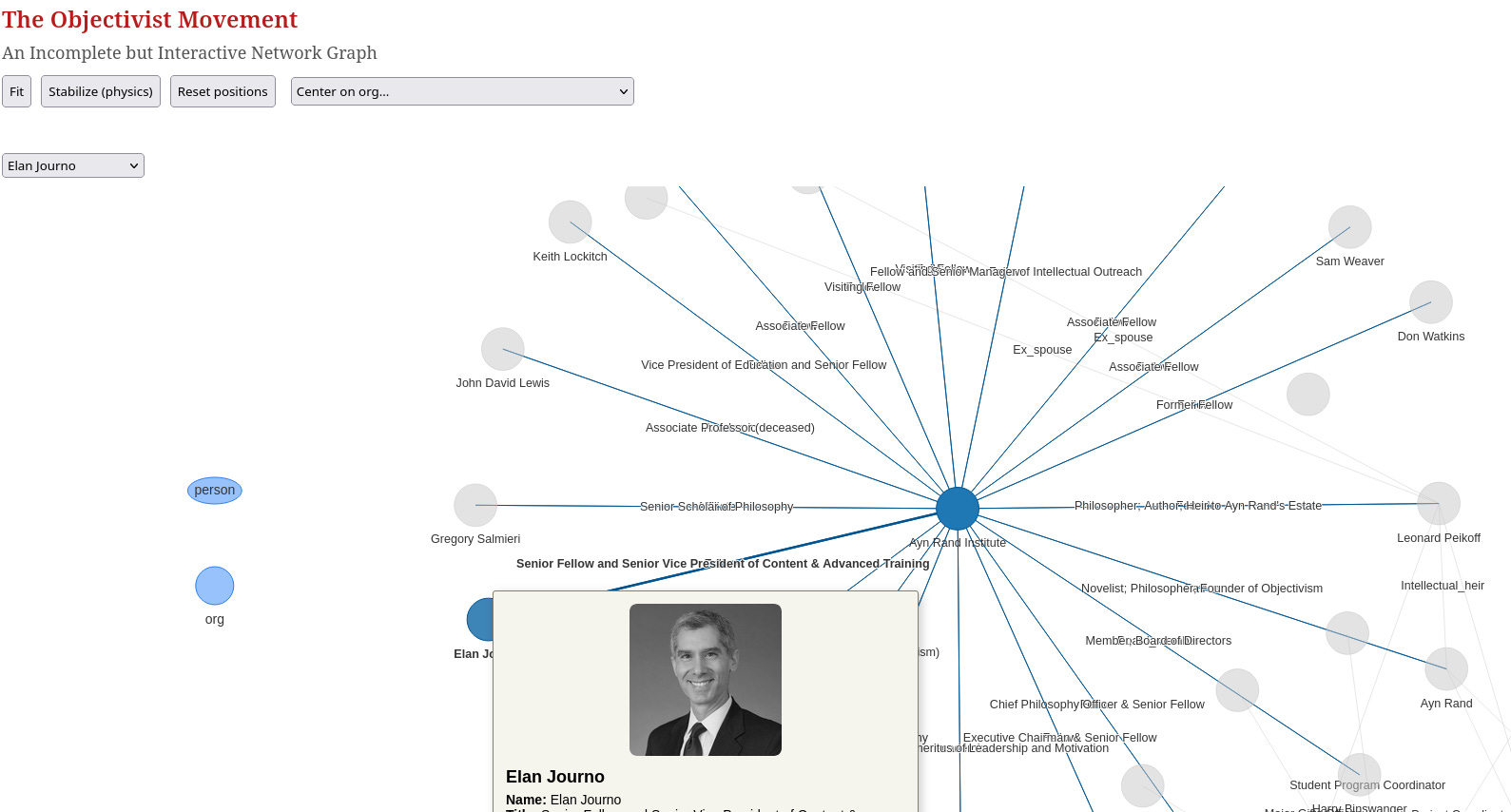
The graph web apps are currently hosted here and on WhoNeeds.It.
Context
A year ago next week, this stack published one of its first Substack articles in an attempt to find other Substack blogs that had been publishing on Ayn Rand or her philosophy of moral objectivism. The motivation was to learn about the “landscape” of a topic of interest on this platform, using data science techniques. To that end, RSS feeds were used in data crawling and scraping this data.
The results were incomplete and noisy, but it was a mildly useful first attempt. They were published within the article as a list of titles, authors, and hyperlinks.
Although a follow-up article did not soon materialize, a database of people, entities, and facts related to objectivism was created on CloudFlare D1 SQLite for the purpose of self-education. The scope of that project has grown large enough to bring us full circle to updating data on objectivism-related Substack publications as well.
The Database
The data behind the graphs consists of information on objectivists, their organizations, related Substacks, and trivia. Initial data sourcing involved reading and “data scraping” of the websites of the Ayn Rand Institute, the Objectivist Standard Institute, and The Atlas Society, in addition to blogs from the “Objectivism on Substack” article.
The programmatically collected data was very messy, i.e., it had lots of mistakes and inconsistently typed proper names, but it has been cleaned and reviewed manually. The process is ongoing, and some organizations are still missing records showing connected individuals. Corrections and contributions are welcome.


The trivia component of the website followed a similar pattern. Originally, a Python script was being used to batch process large chunks of raw text from all of Rand’s works, which in turn were used to generate multiple-choice questions and store them in the database. It generated 8,000 questions.
Unsatisfied with the quality of too high a proportion of those questions, a decision was made to limit the quiz to only manually reviewed questions. At present, only 200 of the questions have been reviewed, which are available in the quizzes on WhoNeeds.it, but hopefully this number will increase over time.
The Updated Objectivist Substack List
Last year’s article included a directory of objectivist and Rand-related substacks, but it was based on an overly simplistic keyword search strategy that utilized Substack’s publication/note search and RSS feed scraping. This year it was expanded by manually searching the names of individuals in our D1 database on Substack’s profile search.
Although many new blogs were discovered, the list is still likely incomplete. Please report any omissions.
Ayn Rand Institute, Fellow
PhD, philosophy
Co-founder of thoughtful.community
Fossil fuel advocate
Author of Think Right or Wrong, Not Right or Left
Ayn Rand Institute
Author of Postsocialist Capitalism: The Rise of Enlightened Individualism (as Ason Rand) and Postsocialist Press
Course designer of “Moral Philosophy: A Survey of Ethics from Ancient to Modern Times” and various AI/DS courses
Archivist, ARI
“Exploring ideas from the perspective of Objectivism”
The Ayn Rand Society, affiliated with the American Philosophical Association, Eastern Division
Archivist
Ayn Rand Archives
Prof. of Political Philosophy. Executive Director of the Clemson Institute for the Study of Capitalism
“The Redneck Intellectual”
Education tycoon
Objective Standard Institute grantor
Prometheus Foundation founder, grantor
Professor of Philosophy
Weekly Wonderings
PhD, philosophy
Author of Loving Life, Rational Egoism, and host of the Under Standing podcast
Executive Director, Objective Standard Institute
Editor in Chief, The Objective Standard (journal)
Sparing partner of Carl Barney
Chairman, Ayn Rand Institute
Books include: What Justice Demands, Failing to Confront Islamic Totalitarianism, and Illuminating Ayn Rand
Philosophy at the University of Texas, Austin
Senior fellow at the Civitas Institute
Co-editor: A Companion to Ayn Rand (Wiley, 2016), Foundations of a Free Society (UPP, 2019) and Two Philosophers (UPP, 2026)
PhD in Philosophy, Columbia U.
Latest books: How We Know and Ayn Rand’s Philosophic Achievement
Taught: U. Texas/Austin, Hunter College (CUNY), New School for Social Research, the Ayn Rand Institute
Senior fellow, Hoover Institution, Stanford University 💪
Author of the bestselling books Dereliction of Duty, Battlegrounds, and At War With Ourselves
Distinguished visiting fellow at Arizona State University
OSI Marketing Manager
Professor Emeritus of History and Philosophy of Science
Reinterpreting Ayn Rand through the lens of “The Living Ego”
VP of Education and Senior Fellow of the Ayn Rand Institute
Ex-christian sharing his journey from religion to rational philosophy
Author of The Moneyball Method
Author of Rational Optimist Society
Associate Fellow at the Ayn Rand Institute
Nikos Sotirakopoulos (Objectobot)
Memes, Quotes, Comics, and Opinions promoting Objectivism
Chief Philosophy Officer, The Ayn Rand Institute
Author of Defending Free Speech and Co-author of Profit Without Apology: The Need to Stand Up for Business
Author of The Tyranny of Need and Libertarianism: The Perversion of Liberty
Founding Editor & Publisher of The Intellectual Activist (1979-1990)
Former Chairman of the Board, and now Distinguished fellow, Ayn Rand Institute
Sr. fellow, The Atlas Society
Prof. of (ancient) Philosophy
Retired
A new perspective on Ayn Rand’s philosophy, focusing on the law of cause and effect
“Prophet of Causation” Substack blog author
Associate Fellow at the Ayn Rand Institute
Autonomia
Former intern on Leonard Peikoff’s “Keeping It Real” podcast
Commentary from a filmmaker and Objectivist
CEO, Ayn Rand Institute
Leverages Ayn Rand’s moral framework to help business leaders tackle ideological challenges
The Objective Standard (TOS Admin)
Commentary from an Objectivist perspective
Alex Bleier and Kevin Osborne
Funded by the Prometheus Foundation
17 years at Ayn Rand Institute
Retired civil litigator
CEO of Alexa Real Estate
Ayn Rand Institute’s Chairman of the Board and former CEO
General political blogs and culturally linked off-topic stacks (i.e., Daniel Donnelley, Don’t Let It Go, The Applied Libertarian, etc.) are currently excluded but can be at added by request.
What’s Available
At the time of writing, you can access the Python-based network graphs of substacks on WhoNeeds.it. That site was built using a GitHub account that has been locked for nearly a week. For that reason, a separate, enhanced version of the graph widget was written using the R language. The newer graph is available here.
For those with an interest in AI code generation, note that the Python version was created using GitHub Co-pilot with the human (me) prompting, testing, and correcting errors. The R version is completely human-written, on the other hand. Surprisingly, they both took about the same amount of time. Let me know if you find quality differences.
The newer graph supports scrolling, zooming, filtering, images, and external links. It does not (yet) have a separate tag for Substack.